History of Mathiravilai
Historical and religious significance of Mathiravilai
In Kanyakumari district, amidst a blooming garden where various religions have thrived and intellectual conversations have flourished, is Pattankadu, also known as Mathiravilai. As per local tradition, this esteemed site associated with legendary wise individuals was believed to be the endpoint of a sacred pilgrimage thus earning its name Mathiravilai.
The Visit of Saint Thomas: Historical and Religious Significance
In Kanyakumari district, amidst a blooming garden where various religions have thrived and intellectual conversations have flourished, is Pattankadu, also known as Mathiravilai. As per local tradition, this esteemed site associated with legendary wise individuals was believed to be the endpoint of a sacred pilgrimage thus earning its name Mathiravilai.
Temples and Worship
In AD 1485, a small temple thatched with palm leaves was constructed for worship. In the 16th century, Saint Francis Xavier visited Kanyakumari when the Nayaka king of Vijayanagara threatened war against the Chera kingdom. Seeking St. Xavier’s help the Chera king won the battle and in gratitude Chera king given the coastal areas for Christian preaching St. Xavier travelled extensively and spreading Christianity town to town including in the Mathiravilai areas.
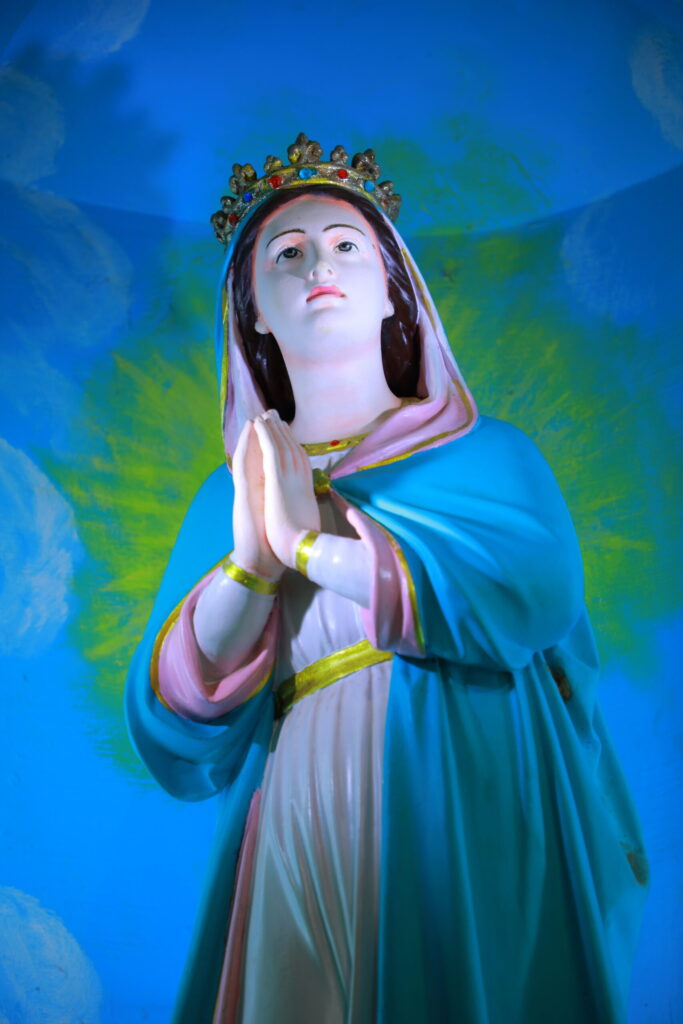
By AD 1555, a temple with stone walls and a roof of coconut leaves was erected for worship. During the 16th and 17th centuries the Travancore government consolidated its rule in Cheranadu coinciding with developments in our temple now adorned with coconut leaf roofing. A crisis struck when the sacred Statue of the Mother went missing from its inner sanctum during a fire outbreak coinciding with a plague epidemic. One morning, to everyone’s astonishment, the Statue of the Mother reappeared in the temple’s central area, and the plague ceased from that day onward. Subsequently temple reconstruction commenced culminating in AD 1615 with the completion of a stone-walled temple featuring a tiled roof and lime mortar plaster.
The Arrival of the Congregation of Jesus: Historical and Religious Impact
During this period, the Society of Jesus (Jesuits) established their presence in Tamil Nadu. It was then that Christianity spread rapidly in the regions of Karankadu, Mathiravilai and Vencode. Consequently our people began to venerate the Heavenly Mother as their protector. In the 17th century, a woman named Arulai came to our area to provide theological education to the growing number of Christians, further advancing the development of Christianity
The Visit of Saint Thomas: Historical and Religious Significance
In Kanyakumari district, amidst a blooming garden where various religions have thrived and intellectual conversations have flourished, is Pattankadu, also known as Mathiravilai. As per local tradition, this esteemed site associated with legendary wise individuals was believed to be the endpoint of a sacred pilgrimage thus earning its name Mathiravilai.
Towards Revival: A Journey of Faith
Since AD 1780, the temple has served as a place of worship under the stewardship of Karankadu. In 1825, the community united to replace the modest temple with a grand structure crowned by a magnificent tower. This initiative marked a significant step in enhancing the temple’s presence and spiritual importance.
In the 8th September 1906, under the guidance of Venerable Benzikar Andagai, Bishop of the Kollam Diocese, the temple was elevated to a separate parish. Rev Fr. Vincent Fernandez was appointed as its first parish priest. A sacred image of the Holy Ascension of the Virgin Mary, adorned with twelve constellations, was brought by sea from Rome to adorn the temple.
During this period, the Good Friday ceremony gained prominence, commemorating the profound sufferings of Jesus Christ in a poignant and lively manner, reinforcing the community’s deep-rooted faith.
Inauguration of the Skyscraper-like Temple
Today, a towering new temple stands proudly, symbolizing faith and community. Its construction began with the foundation stone laid in 1972 by Venerable Bishop Arogyaswamy, during the tenure of Rev Fr. Benedict Alexander. The temple was largely erected under the supervision of Eugene Kulanthai and was completed during the reign of Rev Fr. Josepraj.
After years of meticulous construction, the temple was consecrated on December 30th, 1984, under the auspices of Venerable Bishop Arogyaswamy Andagai. This momentous occasion marked the culmination of collective effort and devotion, heralding a new era of spiritual significance for its devotees.
Annual Festival of the Ascended Mother
Every year on August 6th, the vibrant flag-off ceremony initiates the festivities honouring the Ascended Mother, drawing devotees from near and far of Kanyakumari district. Spanning ten days of reverence and celebration, the festival culminates on August 15th.
Throughout the festival, devotees flock to the temple, seeking the blessings of the Mother. On the final day, the highlight is the ceremonial circling of the temple by the Mother’s chariot. Devotees express their gratitude by offering flower garlands and salt, symbols of their deep appreciation for the Mother’s blessings.
The culmination of the festival includes the Therpavani, a solemn procession where devotees participate in Eucharistic Adoration within the temple. Here, they receive the blessings of the Eucharistic Lord, filling their hearts with joy as they depart for their homes.
May the grace and blessings of our blessed Mother stay with us forever. May you be blessed with Mother’s blessings. Let us live happily together.